
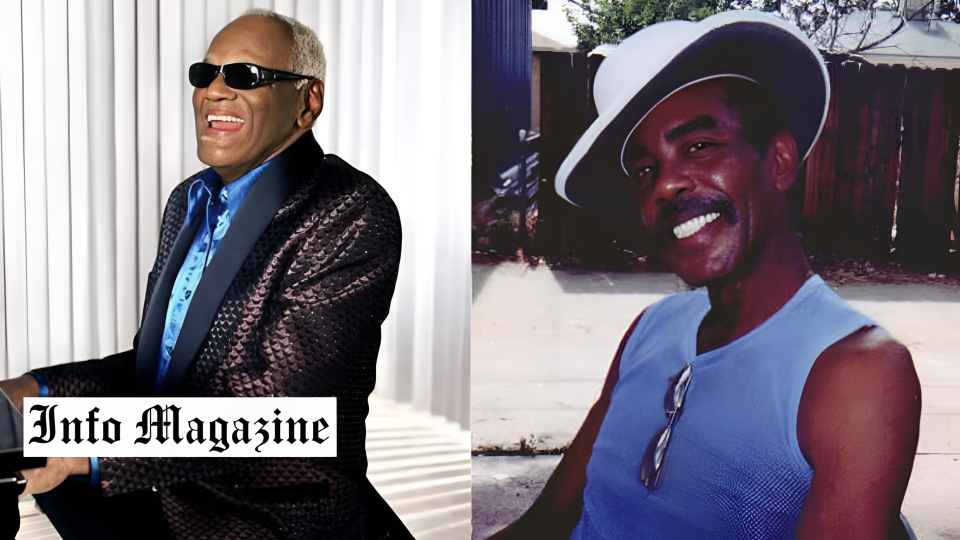
There are names that become famous because of what a person accomplished, and there are names that remain recognizable because of the family history surrounding them. Charles Wayne Hendricks belongs to the second category, but his story is more complicated than a simple footnote in the biography of a legendary musician.
Born into the world of Ray Charles and Margie Hendrix, he entered a family already connected to one of the most important chapters in American rhythm and blues. His father would become an enduring musical icon, while his mother was a powerful singer whose work with the Raelettes placed her inside Ray Charles’ most important musical years. Charles Wayne, however, did not develop a comparable public career of his own. His name survives largely through family history, while much of his personal life remains outside the documented record.
That contrast is what makes Charles Wayne Hendricks interesting. His story is not one of albums, awards, television appearances, or a long professional résumé. It is instead a story about growing up connected to extraordinary fame while remaining comparatively invisible within it.
The distinction matters. A famous parent can make a person’s name searchable, but it does not automatically make the person’s private life public. In Hendricks’ case, the available evidence is strong enough to establish his connection to Ray Charles and Margie Hendrix, his birth date, and his place within the Charles family. Beyond those points, the record becomes considerably thinner.
Charles Wayne Hendricks at a Glance
| Fact | Details |
|---|---|
| Full Name | Charles Wayne Hendricks |
| Date of Birth | October 1, 1959 |
| Place of Birth | New York City, New York, is the birthplace reported in biographical records concerning his birth |
| Nationality | American |
| Profession | No independently documented public profession or long-term career has been reliably established |
| Known For | Being the son of musician Ray Charles and singer Margie Hendrix |
| Years Active | No reliable public record establishes a professional period of activity |
| Net Worth | No reliable public record establishes a personal net-worth figure |
| Marital Status | No reliable public record sufficiently confirms his marital status |
| Spouse | No spouse can be reliably identified from well-established public records |
| Children | No reliable public record confirms the number or identities of his children |
| Education | No reliable public record establishes his schools, degrees, or other formal education |
| Notable Works | No independently documented artistic, entertainment, or published body of work is reliably attributed to him |
| Major Achievements | No independently documented public professional achievements are reliably established |
The strongest biographical records consistently identify Charles Wayne Hendricks as the son of Ray Charles and Margie Hendrix and give his birth date as October 1, 1959. Ray Charles’ documented family history lists him among the musician’s twelve children.
The lack of information in several other categories should not be interpreted as evidence that nothing happened in his life. It simply means that those parts of his biography have not been sufficiently documented in reliable public sources.
That distinction becomes particularly important when researching people who lived outside the entertainment industry.
Born Into the World of Ray Charles and Margie Hendrix
Charles Wayne Hendricks was born at a remarkable moment in American music.
His father, Ray Charles, was already establishing himself as a major recording artist, while his mother, Margie Hendrix, was becoming an important voice in the group that would be known as the Raelettes. The relationship between his parents was personal as well as musical, but the public significance of that relationship comes largely from the extraordinary careers that surrounded his birth.
Margie Hendrix was not simply a singer who happened to know Ray Charles. She was an important vocalist in her own right. Before the Raelettes became associated with Charles, Hendrix had been part of the Cookies, a vocal group that worked in New York’s recording scene and eventually crossed paths with Ray Charles through Atlantic Records. The Raelettes were formally established in 1958, with Hendrix among the original members.
Her voice became an important component of the Ray Charles sound during the late 1950s and early 1960s. The Raelettes contributed to recordings and performances that would become central to Charles’ reputation, including “Night Time Is the Right Time,” “What’d I Say,” and “Hit the Road Jack.”
Charles Wayne was therefore born into a household connected to a rapidly changing musical culture.
That context is important when considering his early life. His parents were not anonymous working musicians. They were part of a professional environment involving recording studios, touring, live performances, musicians, singers, and the emerging commercial power of rhythm and blues.
Yet being born into that world did not mean that Charles Wayne eventually became a performer.
In fact, the available record points in the opposite direction.
His Mother Was an Important Figure in Her Own Right
Much of the public discussion of Charles Wayne Hendricks begins with Ray Charles, but focusing exclusively on his father risks overlooking the significance of Margie Hendrix.
Hendrix had a powerful singing style that made her particularly memorable within the Raelettes. Contemporary accounts and later musical histories have emphasized the force of her vocals, particularly on recordings where the backing singers were an integral part of Ray Charles’ sound.
The Ray Charles organization was a demanding professional environment. The Raelettes were not simply decorative backing singers; their vocal contributions helped create the call-and-response energy that became part of Charles’ musical identity.
The group’s documented history shows how closely Hendrix was connected to this period. She was part of the original Raelettes lineup and was present during some of Ray Charles’ most important early recordings. A timeline of the group also records that Hendrix took time away from performing around the period of Charles Wayne’s birth in 1959.
For Charles Wayne, that meant his earliest family circumstances were tied to a musician who was already building a significant public reputation and a mother who was herself a working recording artist.
It is a remarkable beginning, but it is also a beginning about which relatively little personal information survives.
Growing Up With a Famous Father
Ray Charles eventually became one of the most influential figures in twentieth-century American popular music.
His career crossed boundaries between rhythm and blues, gospel, soul, jazz, country, pop, and other traditions. His work helped shape the development of soul music and earned him a place in the history of American recording.
For readers interested in the larger cultural world surrounding Charles Wayne Hendricks, the broader story of Ray Charles provides essential context.
But Charles Wayne’s own life should not simply be treated as an extension of his father’s biography.
That is one of the most important points in understanding him.
A child of a famous musician can be publicly identified without becoming a public figure. Family photographs, biographical references, and historical records may establish the relationship, while leaving the person’s own ambitions, friendships, education, employment, and adult experiences undocumented.
That appears to be the case here.
There is no substantial archive of interviews in which Charles Wayne explained what it was like to be Ray Charles’ son. There is no established memoir attributed to him. There is no widely documented entertainment career that would provide a chronological account of his adult years.
The absence of those materials makes it tempting to fill the gaps.
A responsible profile should do the opposite.
A Childhood Surrounded by Music, But Not Defined by It
The musical environment surrounding Charles Wayne was extraordinary.
His mother belonged to the Raelettes, a group whose history was closely connected to Ray Charles’ touring and recording organization. The group performed throughout the United States and appeared alongside Charles during an era when rhythm and blues was developing into a dominant force in American popular culture.
Yet there is no strong public evidence that Charles Wayne pursued music professionally.
That is significant.
It would be easy to assume that the son of Ray Charles and Margie Hendrix must have inherited a musical career or followed his parents into entertainment. But parentage is not proof of profession.
The public record does not establish him as a singer, songwriter, instrumentalist, producer, actor, or recording artist.
That does not mean he had no interests in music. It means that no reliable evidence allows those interests to be turned into a documented career.
This distinction is especially valuable when reading online biographies. A person’s association with a famous family can create an expectation that there must be a dramatic professional story somewhere. Sometimes there simply isn’t one.
Sometimes the more accurate story is that the person remained private.
The Loss of Margie Hendrix
One of the defining events surrounding Charles Wayne’s early life was the death of his mother.
Margie Hendrix died in New York City on July 14, 1973, at the age of 38. By then, her relationship with Ray Charles had long since become complicated, and her career had moved through both professional success and serious personal difficulties.
Charles Wayne was still a young teenager.
The loss is therefore an important part of the chronology of his life, even though the surviving public record does not provide enough reliable detail to reconstruct his private emotional experience.
This is another point where biography can easily become speculation.
It would be tempting to write about exactly how the teenager reacted, who raised him afterward, how his relationship with his father changed, or how the loss influenced his adulthood. Some secondary biographies make confident statements about these matters, but the underlying evidence is not strong enough to treat every such claim as established fact.
The safest conclusion is more limited: Charles Wayne lost his mother while he was still young, and the event occurred against the complicated backdrop of Ray Charles’ family and professional life.
That alone was a significant change.
The Ray Charles Family Was Larger Than the Public Image Suggested
Charles Wayne was not Ray Charles’ only child.
Public biographical records identify twelve children born to Ray Charles and nine different women. Charles Wayne appears in that family chronology as the fourth child listed, born in 1959 to Margie Hendrix.
This family structure helps explain why Charles Wayne’s biography can be difficult to reconstruct.
Ray Charles’ personal life extended across multiple relationships and households. His children were born across several decades, and their own public visibility varied dramatically.
Some became involved in entertainment or public life.
Others remained considerably more private.
Charles Wayne falls into the latter category in the available record.
His existence is firmly connected to the family history, but there is no comparable archive documenting his own career.
That difference is worth emphasizing because celebrity family trees can create an illusion of equal visibility. They are not equal. A famous parent’s public biography can be enormous while an individual child’s life may remain almost entirely private.
What Is Actually Known About His Career?
Very little can be established with confidence.
There is no widely recognized profession associated with Charles Wayne Hendricks. Reliable public sources do not provide a substantial résumé, business biography, entertainment filmography, musical discography, or professional portfolio.
That makes “profession” one of the most difficult questions to answer responsibly.
Rather than assigning him a profession based on assumptions or repeating an occupation from an unsupported biography, it is more accurate to describe him as a private individual whose professional life is not sufficiently documented in the public record.
This may sound less dramatic than the typical celebrity biography.
It is also more honest.
A person’s lack of public professional documentation does not make the person unimportant. It simply means the available evidence cannot support a conventional career narrative.
For comparison, readers exploring other profiles of people connected to famous entertainment families can find similar questions of privacy in Sanaa Chappelle’s story and Gina Martin Wilson’s biography. In each case, the distinction between being connected to fame and actively pursuing fame becomes important.
The Difference Between Recognition and Celebrity
Charles Wayne Hendricks is a useful example of a distinction that is often lost online: being recognizable is not necessarily the same as being famous.
His name attracts searches because it connects directly to Ray Charles.
But Charles Wayne did not create the musical legacy for which people search his name.
His public significance comes primarily from genealogy and family history.
That does not make his story meaningless. Quite the opposite. The lives of people surrounding major cultural figures can reveal aspects of history that the headline celebrity biography cannot.
Ray Charles’ story is about music, ambition, artistic innovation, commercial success, and cultural influence.
Charles Wayne’s story raises a different question:
What happens to the members of a famous family who do not become famous themselves?
There is no universal answer.
Some pursue careers away from entertainment. Some appear occasionally in public. Some become involved in family businesses or estate matters. Others disappear almost entirely from public view.
Charles Wayne’s available record gives us very little evidence about which of those paths he followed.
Why the Internet Contains Conflicting Claims About His Later Life
The later years of Charles Wayne Hendricks’ biography require particular caution.
A number of online biographies state that he died in 2013, sometimes giving May 7, 2013 as the date. Other pages repeat additional claims about a wife, children, and the circumstances of his death.
However, the evidence is not sufficiently consistent to present all of those details as established fact.
One particularly important problem is an obituary record associated with a Charles Wayne Hendricks who died in 2013 but is identified as having been born in 1949 rather than 1959. That creates a significant identity problem: the record may concern another person with the same name.
This is precisely the kind of issue that can turn a repeated internet claim into a false biography.
If one website says a person died in 2013 and ten other websites repeat the same date, those ten repetitions do not necessarily constitute ten independent confirmations.
The underlying question is whether the records can be tied to the same individual.
In this case, the birth-year discrepancy makes that connection uncertain.
Therefore, the most responsible treatment is not to state confidently that Charles Wayne Hendricks died in 2013. It is to explain that the date is widely repeated in secondary biographies but cannot be securely established as the death date of Ray Charles’ son without stronger identifying evidence.
What About His Wife and Children?
This is another area where online biographies frequently move beyond the evidence.
Several secondary sources identify a woman named Marlene Hendricks as Charles Wayne’s wife and claim that he had children. Those claims are repeated in some biography-style publications, but they are not sufficiently supported by strong, independently verifiable public records to be presented here as established facts.
The same caution applies to the number of children sometimes attributed to him.
A biography should not turn repetition into certainty.
This is especially important because family relationships are personal information. If a spouse or children are to be identified as factual parts of someone’s life, the evidence should be considerably stronger than an unsourced biography page.
For that reason, this profile does not assign Charles Wayne a confirmed spouse or number of children.
The lack of a definitive public record is itself useful information for readers. It tells us that the public biography ends before those details can be responsibly established.
Why His Privacy Matters
Privacy can seem unusual in celebrity culture because famous families are often treated as open books.
But Charles Wayne Hendricks’ story demonstrates why that assumption can be misleading.
A person can be born into one of the most famous musical families in America and still have a life that is mostly undocumented.
There is something significant about that.
Ray Charles spent much of his adult life on stages, in recording studios, on television, and in the international press. His music generated decades of documentation. His performances were recorded. His professional relationships were discussed. His career was examined repeatedly by journalists, historians, musicians, and biographers.
Charles Wayne experienced the opposite kind of public existence.
His identity is documented primarily because of his family connection.
That means the line between public knowledge and private life is unusually clear.
We know why people search for his name.
We know who his parents were.
We know his birth date.
But we do not have enough evidence to narrate every part of his life.
And that boundary deserves to remain intact.
The Broader Musical Legacy Around His Name
Although Charles Wayne did not establish a widely documented career of his own, his family connection places him close to a major chapter of American musical history.
Ray Charles helped bridge musical traditions that had often been separated by genre and audience. His work drew from gospel, blues, jazz, rhythm and blues, and popular music. His ability to combine those influences made him a central figure in the development of soul.
Margie Hendrix, meanwhile, belonged to a generation of Black women vocalists whose contributions to popular music were sometimes overshadowed by the artists whose names appeared most prominently on album covers and record labels.
The Raelettes’ role was crucial to Ray Charles’ sound. Their vocals helped create the energy of his recordings and live performances, while Hendrix became particularly associated with the emotional intensity of the group’s early work.
That history gives Charles Wayne’s name a cultural context far larger than his own documented public activity.
He was born into the orbit of two performers whose work helped define an era.
That fact is enough to make his biography historically interesting without inventing a career for him.
A Name That Survives Through Family History
The most revealing feature of Charles Wayne Hendricks’ public identity may be the imbalance between his family significance and his personal documentation.
There is extensive material about Ray Charles.
There is substantial musical history surrounding Margie Hendrix.
There is comparatively little about Charles Wayne himself.
That imbalance can be frustrating for readers searching for a complete biography, but it also tells us something about how historical records are created.
Public records tend to preserve the lives of people who participate in public institutions: performers, politicians, athletes, executives, writers, and other visible professionals.
Private individuals can leave far fewer traces.
When a private individual happens to be the child of a celebrity, later generations may become curious about the missing pieces. The internet then attempts to fill those spaces.
Sometimes that process produces useful information.
Sometimes it produces stories that are impossible to verify.
Charles Wayne Hendricks’ biography demonstrates both sides of that problem.
Why Accuracy Matters More Than a Complete-Sounding Story
There is a natural temptation in biography writing to make every section feel complete.
Readers ask about birth, education, marriage, children, career, income, death, and legacy. A conventional biography attempts to answer all of them.
But not every life leaves reliable evidence for every category.
For Charles Wayne Hendricks, the strongest facts are relatively straightforward: his identity, his parentage, his October 1, 1959 birth date, and his position within Ray Charles’ family.
The rest requires varying degrees of caution.
That does not make the profile weaker.
In fact, acknowledging uncertainty makes it stronger because it prevents the creation of a biography that sounds authoritative while resting on unsupported claims.
The same principle applies to net worth.
There is no credible public financial disclosure establishing a personal fortune for Charles Wayne Hendricks. Any precise number circulating online should therefore be treated as speculation rather than established fact.
The same is true of education and profession.
No reliable public archive currently provides enough evidence to turn those subjects into confident biographical statements.
Charles Wayne Hendricks and the Meaning of a Private Legacy
Legacy is often associated with achievements.
A musician leaves albums.
An actor leaves films.
A politician leaves laws and speeches.
A writer leaves books.
Charles Wayne Hendricks presents a different kind of legacy.
His historical relevance comes from family.
He is part of the personal story behind Ray Charles, one of the most influential musicians of the twentieth century, and Margie Hendrix, an important voice within the Raelettes.
That connection places his name within a documented musical family history.
But it does not require transforming him into a celebrity.
There is value in allowing his story to remain proportionate to the evidence.
The most interesting question may not be what secret career he supposedly had or how much money he supposedly possessed.
It may simply be what it meant to exist near enormous fame without becoming famous oneself.
The Enduring Curiosity Around His Name
Search interest in Charles Wayne Hendricks is unlikely to disappear as long as Ray Charles’ music remains part of American cultural history.
Every new generation discovering Ray Charles can eventually encounter the question of his family.
Who were his children?
Who was Margie Hendrix?
What happened to the people connected to him outside the stage?
Charles Wayne becomes part of that larger curiosity.
Yet the most useful way to approach his biography is with restraint.
He was not simply “Ray Charles’ hidden son,” as some sensational headlines describe him. He was a person whose public identity became closely connected to a famous father and a talented mother while his own life remained comparatively private.
That distinction changes the tone of the story.
It turns the biography away from mystery for mystery’s sake and toward a more realistic understanding of how fame affects families.
What Charles Wayne Hendricks’ Story Ultimately Reveals
Charles Wayne Hendricks occupies a fascinating but unusually quiet place in American music history.
His birth connected him to Ray Charles and Margie Hendrix at a moment when both were deeply involved in the development of rhythm and blues. His mother was one of the original Raelettes, and his father would go on to become a defining figure in American music.
Yet Charles Wayne himself did not leave behind a comparable public professional record.
That is not a failure.
It is simply a different kind of life.
The surviving evidence suggests that his importance to the historical record comes primarily through family rather than through a documented public career. Many of the details readers most want to know about him remain uncertain, including his education, profession, personal relationships, financial circumstances, and later-life chronology.
That uncertainty should not be filled with invention.
Instead, it offers a reminder that not every person connected to a legendary figure lived under the same spotlight.
Some people become part of history because millions know their work.
Others become part of history because their names appear quietly within the family story of someone millions remember.
Charles Wayne Hendricks belongs to the latter group.
His story sits behind the louder story of Ray Charles, but that does not make it insignificant. It gives us another way to think about celebrity, family, privacy, and the limits of the public record.
And perhaps that is the most honest legacy his name can carry: not a manufactured tale of fame, but the documented presence of a private individual within one of American music’s most remarkable families.
Frequently Asked Questions About Charles Wayne Hendricks
Who was Charles Wayne Hendricks?
Charles Wayne Hendricks was the son of legendary musician Ray Charles and singer Margie Hendrix. He was born on October 1, 1959, and is listed among Ray Charles’ twelve children. His own professional and public life, however, was far less documented than that of his famous father.
When was Charles Wayne Hendricks born?
Charles Wayne Hendricks was born on October 1, 1959. Public biographical records associated with Ray Charles and Margie Hendrix identify that date consistently.
Who was Charles Wayne Hendricks’ mother?
His mother was Margie Hendrix, a rhythm-and-blues singer and original member of the Raelettes. Hendrix had an important role in Ray Charles’ early recording and touring organization and was particularly known for her powerful vocals.
Who was Charles Wayne Hendricks’ father?
His father was Ray Charles, the American singer, pianist, songwriter, and recording artist whose work helped shape the development of soul and modern rhythm and blues. Charles Wayne is listed among Ray Charles’ twelve children.
Did Charles Wayne Hendricks have a career in music?
There is no reliable public record establishing Charles Wayne Hendricks as a professional musician, singer, songwriter, or recording artist. Although both of his parents were closely connected to music, his own professional activities are not sufficiently documented.
Did Charles Wayne Hendricks have a wife or children?
Several secondary online biographies make claims about a wife and children, but those details are not supported strongly enough by reliable, independently verifiable public records to be presented as confirmed facts. The safest conclusion is that his marital and parental history remains insufficiently documented publicly.
What was Charles Wayne Hendricks’ net worth?
There is no reliable public financial record establishing Charles Wayne Hendricks’ personal net worth. Numerical estimates found online should not be treated as factual unless supported by credible financial documentation.
Did Charles Wayne Hendricks die in 2013?
Some secondary biographies report that a Charles Wayne Hendricks died in 2013. However, an available obituary record associated with that name identifies a 1949 birth year, while Ray Charles’ son is consistently documented as having been born in 1959. Because of that discrepancy, the 2013 death record cannot safely be treated as definitive proof that Ray Charles’ son was the person who died.
Why is Charles Wayne Hendricks still searched today?
Interest in Charles Wayne Hendricks largely comes from his connection to Ray Charles and Margie Hendrix. Ray Charles’ enduring cultural influence continues to generate interest in his family, while Margie Hendrix’s role in the Raelettes adds another important musical connection to Charles Wayne’s biography.
What is the most reliable way to understand Charles Wayne Hendricks’ story?
The most reliable approach is to separate documented facts from repeated online claims. His identity as Ray Charles’ son, his connection to Margie Hendrix, and his October 1, 1959 birth date are substantially supported. Many details about his career, marriage, children, finances, education, and later life remain insufficiently documented and should not be presented as certain without stronger evidence.
A Quiet Place in a Very Loud Family History
Charles Wayne Hendricks’ story does not end with a famous recording, a stage performance, or a celebrated career. Its significance comes from something quieter.
He was born into the family of Ray Charles and Margie Hendrix, two people whose lives were deeply connected to a transformative period in American music. His mother’s voice became part of the Raelettes’ history, while his father’s work eventually became part of the permanent American musical canon.
Charles Wayne’s own public record is far smaller.
That may be precisely why his story deserves a careful profile rather than a sensational one.
His biography reminds us that fame does not spread evenly through a family. A famous surname can create lifelong curiosity without creating a public career. It can place someone inside history while leaving much of that person’s own story undocumented.
In an age when almost every detail of a celebrity’s life can become searchable, that quietness is unusual.
And for Charles Wayne Hendricks, it may be the most defining fact of all.
For More Visits: Infomagazine
