
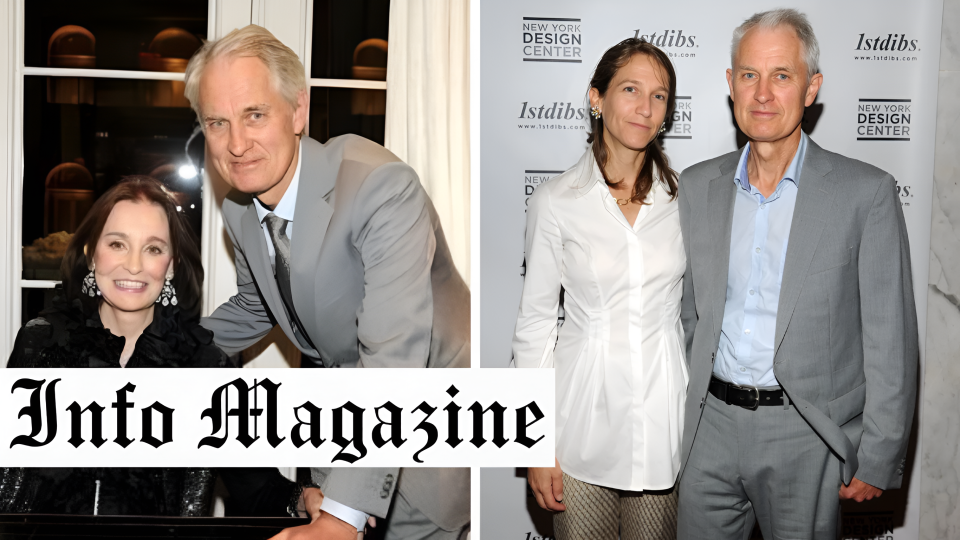
There are famous families whose histories seem almost designed for public consumption. The Vanderbilt name carries generations of American wealth, society, fashion, and cultural influence. The Stokowski name evokes classical music and one of the most recognizable conductors of the twentieth century. Put those two names together, and it would be easy to assume that Christopher Stokowski was destined to live a highly visible life.
Instead, he became known for almost the opposite reason.
Christopher Stokowski has spent much of his life away from cameras, interviews, celebrity events, and the machinery of public attention. He was born into the marriage of heiress and artist Gloria Vanderbilt and celebrated conductor Leopold Stokowski, later becoming the half-brother of CNN journalist Anderson Cooper. Yet his story is not primarily about using a famous family connection to build a public career. It is about distance, identity, family conflict, privacy, and the complicated consequences of growing up inside a household that was already part of American cultural history.
That contrast is what makes Christopher Stokowski so intriguing. His story raises a question that often gets overlooked when people discuss famous dynasties: What happens when someone born into extraordinary visibility wants an ordinary degree of privacy?
Much of the answer remains unknown. Christopher has never built the kind of public record that makes every chapter of a person’s life easy to reconstruct. Some details about his education, artistic interests, relationships, and later years have appeared in public reporting, while other claims have circulated without enough reliable documentation to treat them as established fact. Separating those two categories is essential to understanding him.
Christopher Stokowski at a Glance
| Fact | Details |
|---|---|
| Full Name | Christopher Stokowski |
| Date of Birth | January 31, 1952 |
| Place of Birth | New York City, United States |
| Nationality | American |
| Profession | Private life; publicly documented professional details are limited |
| Known For | Being the son of Gloria Vanderbilt and Leopold Stokowski; his long withdrawal from public family life |
| Years Active | Not reliably established from public records |
| Net Worth | Not reliably established; published estimates are speculative |
| Marital Status | Not reliably established from authoritative public information |
| Spouse | No reliably documented spouse |
| Children | No reliably documented children |
| Notable Works / Achievements | No substantial public body of work reliably documented |
Christopher was born on January 31, 1952, to Gloria Vanderbilt and Leopold Stokowski. Contemporary and historical biographical records consistently identify him as one of their two sons.
Born Between Two Extraordinary Legacies
Christopher entered the world at the intersection of two very different kinds of American fame.
His mother, Gloria Vanderbilt, belonged to one of the country’s most recognizable wealthy families. But reducing Vanderbilt to an heiress misses much of what made her public life unusual. She became an artist, writer, actress, fashion figure, and designer, continually reinventing herself instead of simply relying on her family name.
His father, Leopold Stokowski, occupied a completely different cultural sphere. Born in London, he became an internationally celebrated conductor whose career included major American orchestras and a long association with the Philadelphia Orchestra. He was also associated with Walt Disney’s Fantasia, which introduced his conducting to an enormous popular audience.
Their marriage brought together inherited wealth, artistic ambition, classical music, New York society, and media attention.
The couple married in 1945 and had two sons: Leopold Stanislaus Stokowski, generally known as Stan, born in 1950, and Christopher, born in 1952. The marriage ended in divorce in 1955.
For Christopher, therefore, the famous surname was not something added later in life. It was part of his identity from birth.
Yet the significance of that background should not be confused with evidence about his own ambitions. Being raised around artists, musicians, wealthy relatives, and public figures may have shaped his environment, but there is not enough reliable public evidence to reconstruct his childhood day by day or to claim exactly how he felt about growing up in that world.
That distinction matters because Christopher’s later life has often encouraged people to fill the gaps with assumptions.
A Childhood Surrounded by Art and Attention
The environment surrounding Christopher was unusually creative.
His mother had a strong interest in painting, writing, fashion, acting, and design. His father devoted his life to music and conducting. Christopher therefore grew up with artistic achievement on both sides of his immediate family.
But the Vanderbilt household was not simply an artistic home. Gloria Vanderbilt had been famous from childhood, and her personal life had long been followed by newspapers and magazines. Her marriages and career continued to attract attention throughout Christopher’s youth.
After divorcing Leopold Stokowski, Vanderbilt married filmmaker Sidney Lumet and later writer Wyatt Cooper. Her marriage to Cooper produced two more sons, Carter Vanderbilt Cooper and Anderson Cooper. As a result, Christopher became the older half-brother of Anderson Cooper and Carter.
That family structure would become particularly important decades later.
Christopher’s relationship with Anderson is one of the most recognizable elements of his story today, but it is important to remember that Anderson Cooper was not initially the internationally known broadcaster audiences know today. The two boys belonged to different stages of their mother’s life and grew up with different family circumstances.
Christopher was already an adult by the time Anderson was building his own public identity.
The Pull of Music
One of the more persistent details associated with Christopher Stokowski is his connection to music.
That association is easy to understand. His father was one of the defining conductors of his generation, and classical music was therefore woven into the family’s history. Some biographies have described Christopher as a musician and linked him to classical music, but the public record surrounding his professional activities is unusually thin.
This is where a responsible biography needs to resist the temptation to turn scattered reports into certainty.
There is no substantial, independently documented catalog of recordings, concerts, compositions, orchestral appointments, or major professional awards that can confidently be attributed to Christopher Stokowski. Claims that he worked extensively under an alias or established a significant hidden musical career have circulated online, but those claims are not sufficiently documented to present as established biography.
What can reasonably be said is that music has remained an important part of the narrative surrounding Christopher, partly because of his father’s enormous musical legacy and partly because accounts of his later life have repeatedly connected him with artistic interests.
The absence of a public professional record is itself revealing.
For a person carrying the Stokowski name, remaining unknown would have required a very different approach to career and publicity than the one followed by his father.
Education and the Search for an Independent Identity
Christopher is widely reported to have attended Bard College in New York. Public biographical accounts associate his education with an interest in the arts and music, although detailed academic records and a complete account of his studies are not publicly available.
Bard’s reputation as a liberal arts institution makes the association especially interesting in the context of Christopher’s life. The college has historically attracted students interested in creative disciplines and independent intellectual work.
Still, it would be too simplistic to claim that attending Bard automatically determined Christopher’s later choices.
His adulthood appears to have developed around a much bigger issue: how to define himself separately from his family.
That challenge is easy to underestimate.
For someone born into an ordinary family, choosing a profession is largely a personal decision. For someone carrying the surname Vanderbilt or Stokowski, nearly every public decision can become part of a larger family narrative. A career choice can be interpreted through the achievements of parents. A romantic relationship can attract attention because of the family name. Even choosing not to participate in public life can become newsworthy.
Christopher ultimately became an example of that paradox.
The less he appeared, the more interesting his absence became.
Why Christopher Stokowski Became So Private
Christopher’s withdrawal from public life is the defining mystery surrounding him.
According to reporting that emerged years later, he became estranged from his family in 1978. The circumstances have frequently been connected to difficulties surrounding his relationship with April Sandmeyer and the role of his mother’s therapist, Christ Zois. However, many of the detailed claims surrounding the dispute come from secondary reporting, and Christopher himself has not publicly provided a comprehensive account that would allow every allegation to be treated as settled fact.
The broad outline is clearer than the disputed details.
Christopher was a young man in his twenties when he separated himself from the family. What followed was an extraordinary period of privacy that lasted for decades.
Gloria Vanderbilt herself discussed Christopher’s absence in the 2016 documentary Nothing Left Unsaid. At that time, she described the painful distance between them and said she believed he did not want contact.
The story therefore was not simply one of a celebrity child becoming a recluse.
It was a family rupture.
And because the family involved was the Vanderbilt family, even a private rupture eventually became a public story.
The Cost of Walking Away
Leaving a famous family can sound glamorous from the outside.
In reality, it can mean giving up access to an entire social ecosystem.
Christopher’s disappearance from family life meant that he was absent from many of the events that defined the later history of Gloria Vanderbilt’s family. He was no longer part of the public narrative surrounding his mother, and he did not participate in the emerging celebrity of his younger half-brother Anderson Cooper.
The decision also created a strange contradiction.
Christopher was increasingly famous for not being famous.
People became curious about him precisely because he was missing.
That dynamic is particularly visible in modern internet culture, where biographies frequently attempt to fill every blank in a person’s life. A private person can quickly become the subject of pages claiming to know their income, relationships, occupation, residence, hobbies, and daily activities.
In Christopher’s case, many such claims conflict with one another.
Some pages describe him as a musician. Others attach specific financial figures to him. Some state that he has never married, while others simply provide no information about his relationships. There is no sufficiently authoritative public record supporting the precise net-worth numbers frequently repeated online.
That is why the most accurate account of Christopher Stokowski is sometimes the one that admits what remains unknown.
The Vanderbilt Name Was Never the Whole Story
Christopher’s connection to the Vanderbilt family inevitably dominates search results, but the Vanderbilt legacy itself deserves some context.
The family became one of America’s great industrial fortunes through Cornelius Vanderbilt’s railroad and shipping interests. By the twentieth century, however, the meaning of the Vanderbilt name had evolved beyond business.
It represented old wealth, social prestige, architecture, fashion, art, and celebrity.
Gloria Vanderbilt inherited part of that cultural legacy but also transformed it. Her career eventually included fashion and designer denim, making her surname commercially recognizable in a completely different way. She became a public personality in her own right rather than merely a descendant of Cornelius Vanderbilt.
Christopher inherited that complicated history.
But unlike his mother, he did not appear interested in converting family recognition into a public personal brand.
That difference is central to understanding his story.
His Father’s Shadow Was Just as Significant
The Vanderbilt side of Christopher’s background often receives more attention because of Gloria Vanderbilt and Anderson Cooper.
Yet Leopold Stokowski was an extraordinary figure in his own right.
His career stretched across much of the twentieth century. He conducted major orchestras, made numerous recordings, experimented with orchestral sound, and became one of classical music’s best-known personalities. His association with Fantasia also made his image familiar to people who might never have attended a classical concert.
Christopher therefore had two powerful legacies surrounding him.
One was a family name associated with wealth and social history.
The other was a family name associated with music.
That combination could have produced an obvious path toward public recognition.
Christopher instead moved in the opposite direction.
The Relationship With April Sandmeyer
April Sandmeyer occupies an important place in the public story of Christopher Stokowski, but this is another area where the documented record is narrower than many online biographies suggest.
She was described in reporting as Christopher’s former fiancée and later became one of the links between Christopher and his family after decades of estrangement.
The relationship was reportedly central to the events that preceded his withdrawal in 1978. Yet the exact private circumstances are not fully documented, and Sandmeyer herself has been careful in public comments about what she was willing to disclose.
That restraint is important.
It demonstrates that the people closest to Christopher have generally not attempted to turn his private life into a full public narrative.
Even when his story became news again, there remained significant boundaries around it.
Four Decades of Silence
The length of Christopher’s estrangement is perhaps the most remarkable fact in his biography.
Nearly four decades passed between his disappearance from the family and his eventual reconnection.
During those years, the world around his family changed dramatically.
His mother became an established fashion and cultural figure. His younger half-brother Anderson Cooper became a nationally recognized journalist and television personality. His half-brother Carter died in 1988, a devastating event that profoundly affected the family.
Christopher was largely absent from this public family history.
That absence did not necessarily mean that he had no relationship with the past. It simply meant that he chose not to participate in it publicly.
This distinction is particularly important.
A person can leave a family without ceasing to care about it. Likewise, reconciliation does not erase the reasons that caused a separation.
Christopher’s story offers little evidence for simplistic interpretations.
It was not a neat tale of rebellion followed by a Hollywood-style happy ending.
It was a long, complicated period of distance followed by a quiet reopening of family connections.
The Documentary That Changed the Story
In 2016, Anderson Cooper and Gloria Vanderbilt appeared together in the HBO documentary Nothing Left Unsaid: Gloria Vanderbilt & Anderson Cooper.
The film focused on the relationship between mother and son and explored Vanderbilt’s extraordinary life.
Christopher was notable partly because of his absence.
The documentary itself brought renewed public attention to the fact that Vanderbilt had another son who had been separated from the family for decades. Around the time of the documentary’s release, Christopher reportedly re-established contact through April Sandmeyer.
Anderson Cooper later confirmed that he and Christopher had reconnected and reconciled.
The reunion was significant precisely because it was understated.
There was no major television special centered on Christopher’s return. No public tell-all appeared. No dramatic press tour followed.
Instead, two brothers who had been separated for decades began speaking again.
That may be one of the most human parts of Christopher Stokowski’s entire story.
Reconciliation Without a Return to the Spotlight
It would be tempting to interpret the 2016 reunion as Christopher’s return to public life.
The evidence does not support that conclusion.
Reconnecting with family is not the same thing as becoming a public figure.
Christopher remained largely private after the reunion. The family did not suddenly begin publishing detailed accounts of his life, and he did not turn the renewed attention into a conventional celebrity career.
That suggests that reconciliation and privacy were not mutually exclusive.
He could reconnect with his family while maintaining boundaries around the rest of his life.
This is an important distinction in an era when celebrity culture often treats personal disclosure as the price of recognition.
Christopher’s example suggests another possibility: a person can be part of a famous family without being available to the public.
What Is Known About His Career?
This is one of the questions most frequently asked about Christopher Stokowski, and also one of the easiest to answer inaccurately.
There is no comprehensive public career biography comparable to those available for his parents or Anderson Cooper.
Some secondary sources have described him as a musician, particularly in connection with classical music. Other reports have suggested that he pursued creative work privately.
But the publicly documented record does not provide enough information to construct a detailed professional timeline.
There are no well-established lists of major employers, albums, orchestral positions, awards, business ventures, or publicly reported salaries that can responsibly be presented as fact.
That does not mean Christopher did nothing.
It means that his professional life did not become a sufficiently public record for outsiders to reconstruct with confidence.
For a man whose entire adult identity seems to have been shaped partly by a desire for privacy, that absence may be intentional rather than accidental.
Christopher Stokowski and the Question of Net Worth
Searches for Christopher Stokowski often produce specific net-worth figures.
Those numbers should be treated cautiously.
There is no reliable public financial disclosure that establishes Christopher’s personal net worth. He has not built a highly visible public career with transparent salaries, corporate holdings, entertainment contracts, or business valuations that would allow a credible calculation.
His connection to Gloria Vanderbilt also does not automatically reveal his personal finances.
Vanderbilt’s wealth, inheritance, business history, and estate arrangements were matters that attracted substantial public attention, but those facts should not be confused with Christopher’s own financial position.
For that reason, the most responsible answer to the question “What is Christopher Stokowski’s net worth?” is that it is not reliably known from public information.
Any precise dollar amount should be regarded as an estimate rather than established fact.
Was Christopher Stokowski Married?
Another frequently searched question concerns Christopher’s marital status.
The public record does not provide enough authoritative information to confidently state that he has or has not married.
His relationship with April Sandmeyer is well established in reporting as part of the story of his estrangement, but that does not establish a later marital history.
Likewise, the absence of public information about a spouse or children should not automatically be interpreted as proof that none exist.
Christopher’s entire adult life has been characterized by privacy.
Therefore, claims about his current family situation should be approached carefully unless they are supported by a reliable first-hand or authoritative source.
Why His Privacy Became Part of His Legacy
There is an irony at the heart of Christopher Stokowski’s story.
His family name should have made him easy to find.
Instead, it helped make his absence fascinating.
The public is accustomed to celebrity biographies that move in predictable directions: childhood recognition, career success, relationships, wealth, awards, and continued visibility.
Christopher’s story does not follow that structure.
His most consequential decision may have been to step away.
His most discussed relationship may be one that was largely lived away from cameras.
His most significant family moment in decades was not a public performance but a private reconciliation.
And his greatest distinction may be that he resisted becoming a public personality even though almost every circumstance of his birth could have pushed him toward one.
Public Perception Versus Documented Reality
The internet has created a peculiar problem for private people connected to famous families.
Once a name becomes searchable, speculation can begin to look like biography.
Christopher Stokowski is a good example.
Online pages have variously presented him as a musician, recluse, artist, businessman, heir, or completely unknown private citizen. Some provide precise figures for his wealth or detailed accounts of his personal life without clearly demonstrating where those details originate.
A careful reading produces a more restrained picture.
We know when Christopher was born. We know his parents. We know his family connections. We know that he became estranged from his family in the late 1970s. We know that his story resurfaced publicly in connection with the 2016 documentary involving Gloria Vanderbilt and Anderson Cooper. We know Anderson subsequently confirmed that they had reconciled.
Beyond that, the boundaries become increasingly important.
The gaps are not failures in the biography.
They are part of the biography.
The Family Story That Keeps Christopher Relevant
Christopher remains relevant today because his story sits at the center of several recognizable themes.
There is the Vanderbilt legacy, one of the most famous American family histories.
There is Leopold Stokowski’s musical legacy.
There is Gloria Vanderbilt’s transformation from heiress into artist, designer, author, and cultural personality.
There is Anderson Cooper’s rise from a famous family into a major journalism career.
And then there is Christopher, who responded to the same family circumstances by becoming increasingly private.
That contrast makes him unusually compelling.
A family can contain people who seek the spotlight and people who avoid it. Neither choice necessarily makes one person more successful or more fulfilled than the other.
Christopher’s life is interesting precisely because it resists the assumption that public visibility is the natural destination of privilege.
What Christopher Stokowski’s Story Says About Identity
There is a broader lesson in Christopher’s life.
A surname can open doors, but it can also create expectations.
Being the child of Gloria Vanderbilt and Leopold Stokowski meant Christopher was born with a remarkable cultural inheritance. But inheritance is not the same thing as identity.
His father represented the world of professional music. His mother represented a combination of wealth, art, fashion, and media culture. His half-brother became a journalist whose career depended on being visible and communicating with millions of people.
Christopher’s apparent choice was different.
Rather than allowing his family identity to determine his public persona, he appears to have prioritized distance from it.
That does not make him an anti-celebrity in any formal sense. It simply shows that a famous family does not guarantee a famous life.
Where Is Christopher Stokowski Today?
There is very little reliable, current public information about Christopher Stokowski’s day-to-day life.
That lack of information should not be replaced with speculation about where he lives, what he does professionally, whether he is married, or what his finances look like.
The most defensible description is that he has continued to maintain a private existence.
His reconnection with Anderson Cooper in 2016 demonstrated that he had not permanently rejected every family relationship. But there is no evidence that the reunion led him to abandon his preference for privacy.
That distinction remains important in 2026.
Christopher is now in his seventies, but the public still knows far less about him than it does about many other members of the Vanderbilt family. His age may change the context of his story, but it does not make private details public.
Frequently Asked Questions About Christopher Stokowski
1. Who is Christopher Stokowski?
Christopher Stokowski is the son of fashion designer, artist, writer, and heiress Gloria Vanderbilt and renowned conductor Leopold Stokowski. He is also the older maternal half-brother of journalist Anderson Cooper. He became particularly known for his long withdrawal from his family and public life.
2. When was Christopher Stokowski born?
Christopher Stokowski was born on January 31, 1952, in New York City. His birth was during Gloria Vanderbilt’s marriage to Leopold Stokowski. Historical biographical records identify him as the couple’s younger son.
3. Who were Christopher Stokowski’s parents?
His parents were Gloria Vanderbilt and Leopold Stokowski. Vanderbilt was a prominent American artist, designer, writer, and heiress, while Stokowski was an internationally recognized conductor. Their marriage lasted from 1945 until their divorce in 1955.
4. Is Christopher Stokowski related to Anderson Cooper?
Yes. Anderson Cooper is Christopher Stokowski’s maternal half-brother. Anderson and Christopher share Gloria Vanderbilt as their mother. Cooper was born in 1967 to Vanderbilt and her fourth husband, writer Wyatt Cooper.
5. Why did Christopher Stokowski become estranged from his family?
Public reporting connects Christopher’s 1978 estrangement to a complicated dispute involving his relationship with April Sandmeyer and Gloria Vanderbilt’s therapist. Because many details come from secondary accounts rather than a comprehensive public statement from Christopher himself, the circumstances should not be presented as completely settled fact.
6. Did Christopher Stokowski reconcile with Anderson Cooper?
Yes. Anderson Cooper publicly confirmed in 2016 that he and Christopher had reconnected and reconciled after decades of estrangement. The renewed contact followed the release of Nothing Left Unsaid, the documentary about Gloria Vanderbilt and Anderson Cooper.
7. Is Christopher Stokowski a musician?
Christopher has frequently been described in secondary biographies as having an interest in or connection to music. His father was the celebrated conductor Leopold Stokowski. However, there is not enough publicly documented professional material to construct a definitive career history or identify a substantial catalog of works.
8. What is Christopher Stokowski’s net worth?
His net worth is not reliably known. Precise figures published online are generally estimates without enough verifiable financial documentation to treat them as fact. His connection to the Vanderbilt family should not be used as proof of a specific personal fortune.
9. Is Christopher Stokowski married?
His current marital status is not reliably established by authoritative public information. His former relationship with April Sandmeyer is part of the documented history surrounding his estrangement, but that does not establish his later marital status.
10. Why is Christopher Stokowski still interesting to people today?
Christopher remains interesting because his life represents an unusual response to inherited fame. He was born into two extraordinary cultural legacies yet chose a largely private existence. His decades-long estrangement and eventual reconciliation with family members add another layer to a story already connected to Gloria Vanderbilt, Leopold Stokowski, and Anderson Cooper.
A Life Defined by What Was Not Public
Christopher Stokowski’s story is unusual because the missing information is almost as important as the information that survives.
He was born into a family that had every ingredient of a public legend: wealth, art, classical music, fashion, journalism, tragedy, and celebrity. His mother was one of the most recognizable women of her generation. His father was a major figure in twentieth-century music. His half-brother became one of America’s best-known television journalists.
Christopher could easily have followed the same road.
Instead, he largely disappeared from it.
His decision created decades of questions, and the public has repeatedly tried to answer those questions with estimates and assumptions. But the more careful interpretation is also the more compelling one. Christopher Stokowski does not need a manufactured career, an invented fortune, or an embellished private life to be interesting.
His documented journey already says something meaningful about fame.
Sometimes the most revealing person in a famous family is the one who refuses to perform for the audience.
Christopher’s life demonstrates that legacy and identity are not the same thing. A famous surname can define how the world sees someone, but it does not necessarily determine how that person wants to live. His eventual reconciliation with his family also suggests that privacy and connection can coexist. One can step away without permanently closing every door.
That may ultimately be the most important part of the Christopher Stokowski story.
He was born into history, but he did not appear interested in becoming its headline.
And in a culture increasingly fascinated by constant visibility, there is something remarkably distinctive about a person whose greatest public statement has been the choice to remain private.
For additional historical context on the Stokowski family, see the relevant Wikipedia biography of Leopold Stokowski.
For More Visits: Infomagazine
